M²LIC: Democratizing the Creation of Relightable Images using a Targetless, Free-Form, Automated Capture Workflow
Ruggero Pintus, Antonio Zorcolo, Alberto Jaspe-Villanueva, Nicola Pagani, Pietro Francesco Serreli, Giovanna Pietra, Enrico Gobbetti
ACM Journal on Computing and Cultural Heritage To appear
Presented at Eurographics Workshop on Graphics and Cultural Heritage, GCH'26
@Article{Pintus:2026:M2LIC,
 title = {{M$^2$LIC}: Democratizing the Creation of Relightable Images using a Targetless, Free-Form, Automated Capture Workflow},
 author = {Pintus, Ruggero and Zorcolo, Antonio and Jaspe-Villanueva, Alberto and Pagani, Nicola and Serreli, Pietro Francesco and Pietra, Giovanna and Gobbetti, Enrico},
 journal = {ACM Journal on Computing and Cultural Heritage},
 month = {November},
 year = {2026},
 doi = {10.1145/3848518}
 }
Abstract
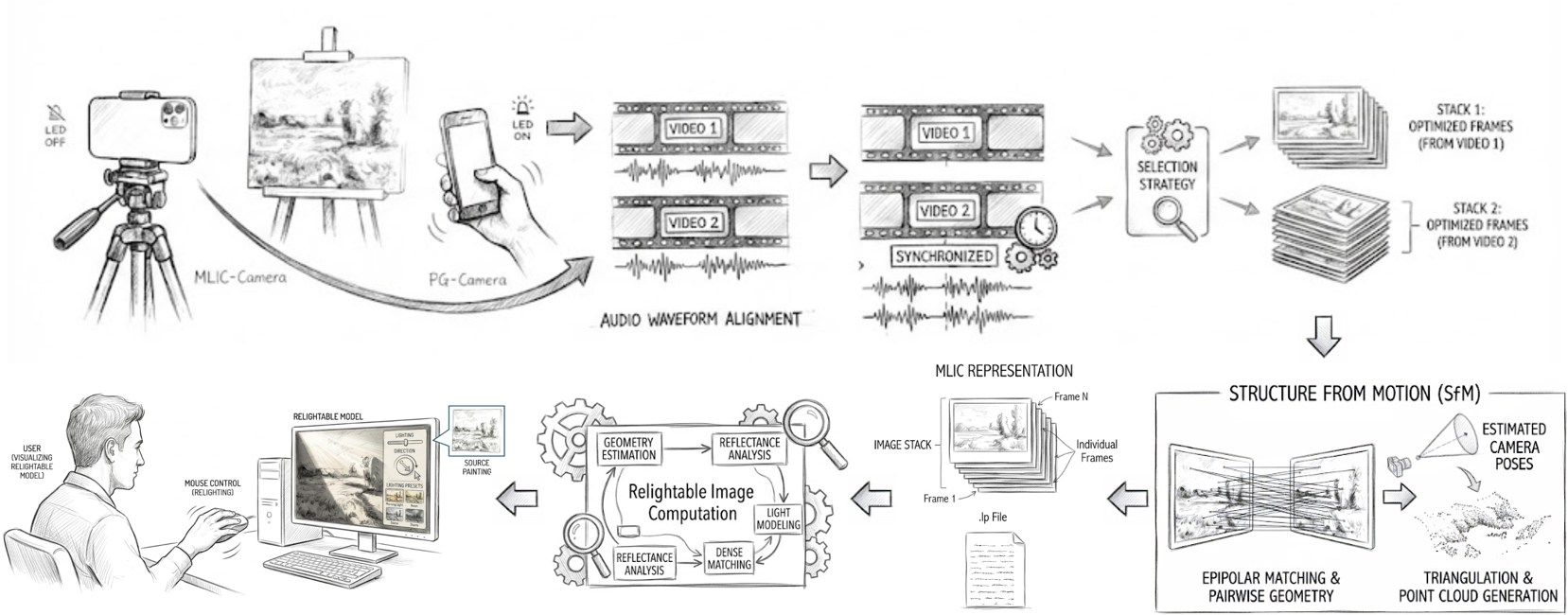
Multi-Light Image Collections (MLIC) are fundamental for virtual re-lighting and detailed surface analysis. In cultural heritage, the most common acquisition approach is free-form moving-light capture, where images taken under varying illumination are later processed to derive shape, material properties, or relightable image models. Despite its flexibility, this workflow remains limited by the need for trained operators, calibration targets, and often significant manual processing. To address these challenges, we present M²LIC (Mobile Multi-Light Image Collection), an automated, target-free pipeline utilizing video recordings from a fixed camera and a moving camera attached to an illuminator. Realizing this setup with just two commodity smartphones lowers hardware costs and technical barriers to entry by leveraging devices that users already own and operate daily. Our framework combines video synchronization, estimation of light directions directly from the scene structure, relighting-aware frame processing, and automatic generation of relightable models ready for web viewing. The protocol is fast and simple, requiring only the simultaneous recording of short videos, allowing operators to produce usable relightable models with minimal training and effort. Validated on a diverse set of artifacts, this open-source system helps lower the barrier to MLIC acquisition and aims to support more scalable MLIC digitization workflows.